Air Assault Ruck Standards: 6-Mile and 12-Mile Requirements
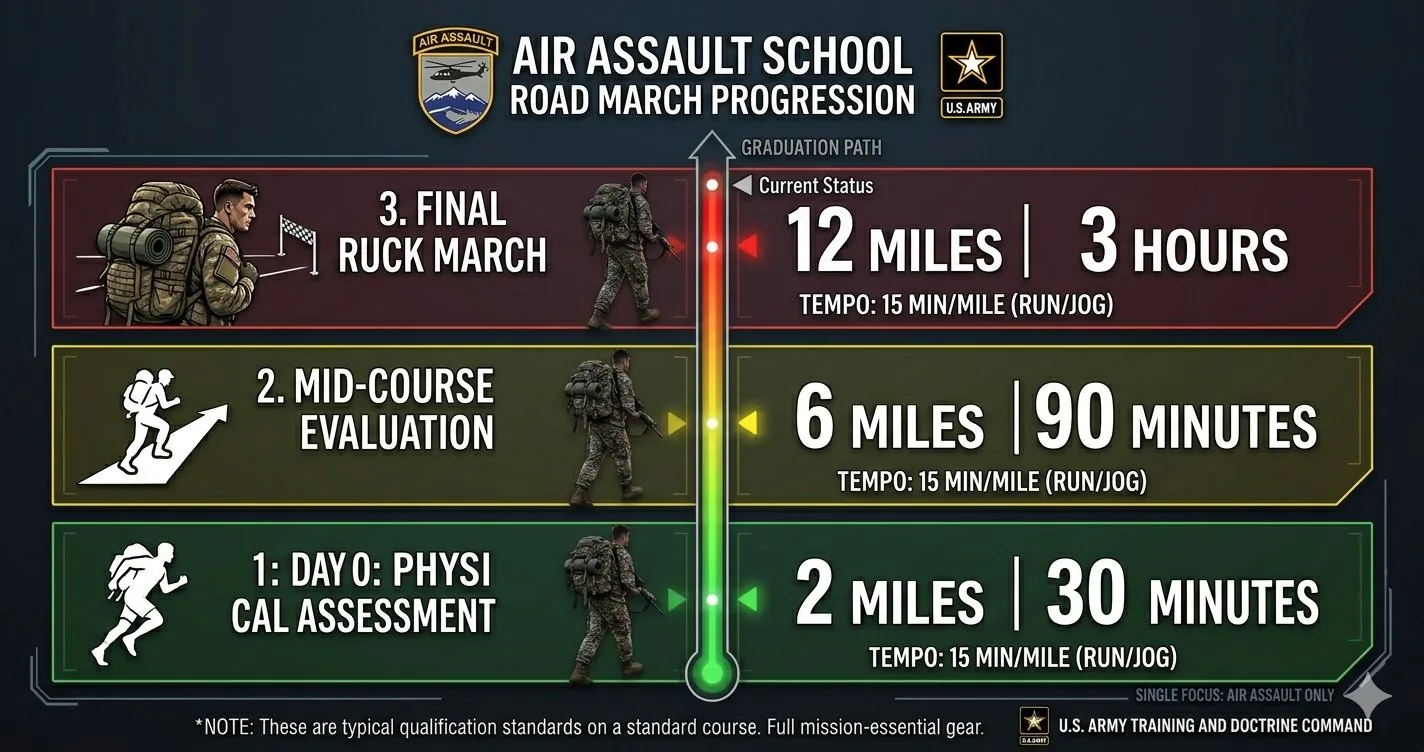
Quick Reference
- 6-mile ruck: 90 minutes, ~35 lbs of gear (15 min/mile)
- 12-mile graduation ruck: 3 hours, ~35 lbs of gear (15 min/mile)
- Pre-qualification: 12-mile unit march under 3 hours to earn a school slot
- Course length: 10 days at the Sabalauski Air Assault School, Fort Campbell
- Pace standard: 15 minutes per mile (4 mph) for both graded marches
What Is Air Assault School?
The U.S. Army Air Assault School is a 10-day course that teaches helicopter sling-load operations, rappelling, and combat assault procedures. It is run primarily at the Sabalauski Air Assault School at Fort Campbell, Kentucky, with other locations such as the Warrior Training Center at Fort Benning and several National Guard academies. Soldiers who pass earn the Air Assault Badge, and the rucking events are where a large share of students fail or drop.
Two ruck marches are graded during the course: a 6-mile march early on and a 12-mile march on graduation day. Both use a pace of 15 minutes per mile, which is the same tempo as the Army's standard 12-mile ruck. The difference at Air Assault is the compressed timeline, the gear inspections that bookend each march, and the fact that you are doing it after days of physical work on little sleep.
6-Mile Ruck Standard
The 6-mile ruck happens in the first phase of the course. According to U.S. Army Central, students carry roughly 35 pounds of gear and must finish within 90 minutes, which works out to a 15-minute mile.
Air Assault 6-mile ruck standard:
| Component | Requirement |
|---|---|
| Distance | 6 miles |
| Time limit | 90 minutes |
| Pace | 15 min/mile (4 mph) |
| Gear weight | ~35 lbs |
| Terrain | Mostly paved/improved road |
Ninety minutes sounds generous, but the march is graded pass/fail and there is no credit for finishing 30 seconds late. Most students who fail do so because they start too slow and try to make up time in the final two miles, when their legs are already cooked. The smarter approach is to bank a small time cushion in the first two miles while you are fresh.
12-Mile Graduation Ruck
The 12-mile foot march is the final graded event. Students step off in the early morning hours, often around 01:30, and must complete the route in under 3 hours with gear to graduate. The pace requirement is again 15 minutes per mile.
Air Assault 12-mile ruck standard:
| Component | Requirement |
|---|---|
| Distance | 12 miles |
| Time limit | 3 hours (180 minutes) |
| Pace | 15 min/mile (4 mph) |
| Gear weight | ~35 lbs (combat loads can run higher) |
| When | Graduation day, early morning |
The cutoff is the same 3-hour standard the regular Army uses for its 12-mile ruck, so anyone who has trained for the standard Army march is already at the right pace. What catches people out at Air Assault is accumulated fatigue from the obstacle course, daily PT, and short nights. Plan to finish closer to 2:30 in training so you have margin on the day itself.
You can check what 15-minute miles mean for your finish time, or work out the pace you need to hit any target, with our ruck pace calculator.
How Much Weight You Carry
The graded standard cited by the Army for the 6-mile march is about 35 pounds of gear. That figure refers to the rucksack and packing-list items. Real loads vary: some classes march in body armor and carry a rubber rifle, which adds another 15 to 30 pounds of fighting load on top of the ruck, and cadet accounts from individual classes report packs closer to 50 pounds.
For training purposes, build to comfortably handle 35 lbs dry at a 15-minute mile, then add a few pounds of margin so the graded weight feels routine. If your unit is known to march in armor, train at least a few sessions in your plate carrier so the load distribution is not a surprise.
| Load element | Typical weight |
|---|---|
| Rucksack (graded standard) | ~35 lbs |
| Body armor / plate carrier | +15–25 lbs (when worn) |
| Rubber rifle / weapon | +5–9 lbs (when carried) |
| Water | Refilled on course at most sites |
Not sure where to start your training weight? Our ruck weight calculator gives a starting load based on your bodyweight and experience.
Pre-Qualification Ruck
Before you ever get to the school, many units run their own qualification to decide who fills their limited slots. A common gate is a 12-mile unit ruck march in under 3 hours, alongside a fitness test and a rope climb. Competitive candidates often finish well under that cutoff; at one National Guard tryout the fastest soldier came in around 2 hours 16 minutes.
If your goal is to earn a slot rather than just pass, train to ruck 12 miles in the 2:15 to 2:40 range with 35 lbs. That margin separates the soldiers who get picked from the ones who barely make the cut.
How to Train for the Standards
The pace target is fixed at 15 minutes per mile, so training is mostly about being able to hold that pace under load when you are tired. Three ideas matter more than any clever programming.
First, build distance before speed. Get comfortable rucking 6 to 8 miles at an easy effort with 35 lbs before you start chasing the time standard. Add distance gradually, no more than about 10 percent per week, to let your feet and connective tissue adapt.
Second, train at the graded weight, not under it. If the standard is 35 lbs, do most of your work at 35 lbs so the load feels normal. The day of the march is not the time to discover how your shoulders handle a full pack.
Third, practice marching tired. The graded rucks come after days of exertion and short sleep, so do at least a few sessions late in the day or the morning after a hard workout. That teaches you to hit pace when your legs are not fresh.
A structured progression helps. Our 12-week ruck training plan takes a beginner up to the 12-mile, 35-lb, 3-hour standard, and the pace guide shows how weight and terrain change your splits.
Frequently Asked Questions
What is the Air Assault ruck standard?
Air Assault School grades two ruck marches. The 6-mile march must be completed in 90 minutes and the 12-mile graduation march in 3 hours, both at a 15-minute-mile pace while carrying about 35 lbs of gear.
How much weight is the Air Assault 12-mile ruck?
The graded standard is roughly 35 lbs of gear in the rucksack. Actual loads can be higher when students march in body armor and carry a rubber rifle, which adds 15 to 30 lbs of fighting load, and some classes report packs near 50 lbs.
What is the time limit for the Air Assault 6-mile ruck?
The 6-mile ruck must be finished within 90 minutes, which is a 15-minute-mile pace. It is graded pass/fail, so there is no allowance for finishing late.
Is the Air Assault ruck harder than the regular Army 12-mile ruck?
The pace and time cutoff are the same 15-minute mile and 3 hours the regular Army uses. What makes Air Assault harder is the context: the march comes after days of physical work, gear inspections, and short sleep, so you have to hit the standard while already fatigued.
How long does it take to train for the Air Assault ruck?
If you already ruck, 6 to 8 weeks of focused training is usually enough to hold a 15-minute mile with 35 lbs. From a non-rucking baseline, plan on 3 to 4 months to build the distance and pace safely.
Train for the Air Assault Standard
Use our calculator to set your pace, plan distance, and track progress toward the 6-mile and 12-mile standards.
Go to Calculator →Sources & Methodology
This guide was compiled and fact-checked by The Ruck Calculator editorial team. The figures are standards-based estimates drawn from official U.S. Army foot-march and fitness publications and reputable training references. Military requirements vary by unit, class, and year, so confirm current standards with your chain of command or the school's cadre before testing.
- Headquarters, Department of the Army. TC 3-21.18, Foot Marches.
- Headquarters, Department of the Army. FM 7-22, Holistic Health and Fitness.