Ranger Ruck Standards: RASP and Ranger School Requirements
Quick Reference
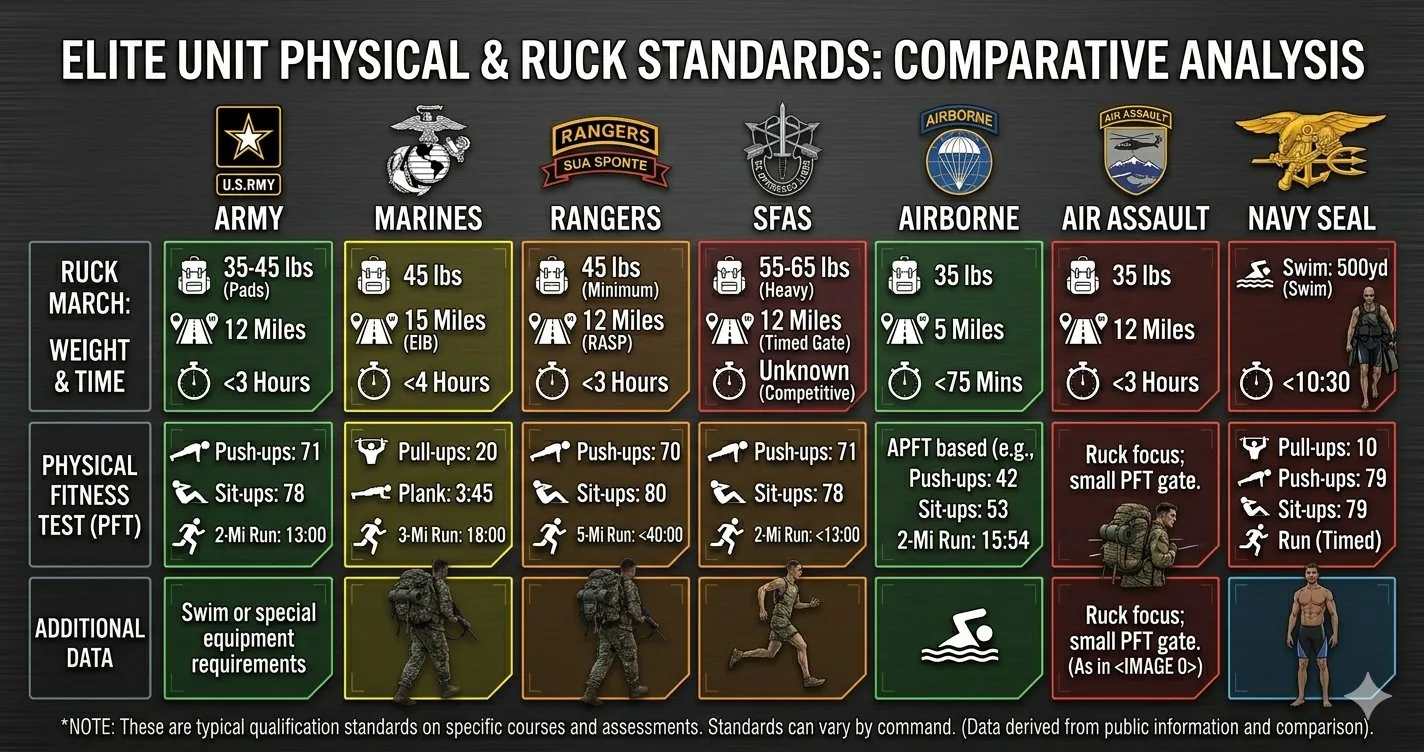
- RASP 12-mile ruck: ~45 lbs, under 3 hours (15 min/mile)
- RASP shorter rucks: 6 miles under 90 minutes is commonly used
- Ranger School loads: ~45–90 lbs depending on phase and mission
- No single Ranger School ruck test: rucking is constant across all three phases
- Competitive prep: 12 miles with 50 lbs in 2:30–2:45
RASP vs. Ranger School
"Ranger ruck standards" actually covers two different things, and confusing them is the most common mistake.
RASP — the Ranger Assessment and Selection Program — is the pipeline to join the 75th Ranger Regiment. It has specific, timed ruck events with clear pass/fail cutoffs.
Ranger School is a leadership course that awards the Ranger Tab and is open across the Army, not just to the Regiment. It does not hang on one timed ruck test; instead, students ruck constantly through three phases under heavy, mission-driven loads. So when someone asks about a "Ranger 12-mile ruck weight," they almost always mean the RASP march, while a question about "Ranger School ruck weight" is really about operational loads. This guide covers both.
RASP Ruck Standards
RASP uses timed foot marches as gates. The headline event is a 12-mile ruck that must be completed in under 3 hours with about 45 lbs of gear — the same 15-minute-mile pace the regular Army uses, but held to a tighter, no-excuses standard.
RASP ruck events:
| Event | Distance | Weight | Time |
|---|---|---|---|
| 12-Mile Ruck March | 12 miles | ~45 lbs | Under 3 hours |
| 6-Mile Ruck | 6 miles | ~45 lbs | Under 90 minutes |
| 4-Mile Ruck (timed) | 4 miles | ~45 lbs | Under 60 minutes |
These are pass/fail. Beyond the rucks, RASP layers in the Ranger Physical Fitness Test, swims, runs, and selection events, all on limited sleep. The rucking is rarely what breaks people on its own — it is rucking while smoked from everything else that does.
Use our ruck pace calculator to see exactly what finish time a 15-minute mile produces over 12 miles, and what pace you need to build in a safety margin.
RASP Is More Than the Ruck
A point worth making, because it changes how you should train: in RASP the ruck is rarely what eliminates people on its own. It is one event inside a multi-day assessment, and candidates fail because of the accumulation, not a single march. The selection also screens:
- The Ranger Physical Fitness Test — push-ups, sit-ups, pull-ups, and a timed 5-mile run, with demanding minimums that are revised periodically (confirm the current standard before you go).
- Water confidence — a combat water survival assessment that catches strong runners who are weak swimmers.
- Land navigation and repeated foot movements — not one ruck but many, on little sleep, often in the dark.
- Psychological and character assessment — boards, peer evaluations, and the simple question of whether you quit when it gets bad.
Because the ruck lands inside that pile, the people who fail it usually do so for predictable reasons. The three most common:
- Feet. Untreated hot spots become blisters become a limp become a slow time. Foot care and broken-in boots win more rucks than raw fitness.
- Going out too fast. Banking time in the first two miles feels smart and wrecks the last four. Even splits at 14–15 min/mile beat a fast start and a death march.
- Training light. Candidates who only ever rucked at 30–35 lbs get surprised by the graded weight on tired legs. Train at or slightly above the standard load.
The takeaway: prepare for the ruck as one demand among several, and arrive with the standard already feeling easy so it survives contact with everything else selection throws at you.
Ranger School Ruck Loads
Ranger School is three phases — Benning (Camp Darby), Mountain (Dahlonega), and Florida (Camp Rudder) — and you ruck through all of them. There is no single graded "ruck test," but movements are frequent, long, and heavy.
| Phase | Typical march | Weight | Pace |
|---|---|---|---|
| Benning (Camp Darby) | 12–15 miles | 45–55 lbs | 15 min/mile |
| Mountain Phase | 8–20 miles | 50–65 lbs | Varies by terrain |
| Florida (Swamp) | 10–15 miles | 55–70 lbs | 15–18 min/mile |
| Pre-Ranger (recommended) | 12 miles | 50 lbs | Under 2:30 |
Loads climb in the Mountain and Florida phases because students carry crew-served weapons, ammunition, and multi-day sustainment gear. On uneven terrain and after days of food and sleep deprivation, a 55–70 lb pack at "patrol pace" is brutal even though the raw mileage looks moderate.
Ranger Ruck Weight Explained
The number that confuses people is "45 lbs." For the RASP timed ruck, that figure refers to the graded pack weight (gear in the rucksack), with required items and water on top. It is the gate weight, not the maximum.
In Ranger School, there is no fixed test weight. The pack is whatever the mission requires, which is why reported loads range from the mid-40s up to 90 lbs. If you are preparing, do not train to just barely carry 45 lbs — build a buffer so the graded weight feels light and the operational loads feel survivable.
For how these loads compare with Army, Air Assault, Marine, and Special Forces standards, see the full military ruck standards guide. To pick a safe starting weight for your own training, use the ruck weight calculator.
How to Train for Ranger Standards
Whether your goal is the RASP 12-miler or surviving Ranger School, three principles drive the training.
Build a margin under the standard. The cutoff is 3 hours for 12 miles, but you should arrive able to do it in 2:30–2:45 with 45–50 lbs. That cushion is what keeps you passing when you are tired, blistered, or the terrain is bad.
Ruck on hard terrain, not just roads. Mountain and Florida phases punish flat-ground-only training. Get on hills, trails, and uneven ground under load so your ankles, knees, and stabilizers are ready.
Practice rucking tired. Selection and the course both grade you on little sleep after hard days. Schedule some rucks the morning after a heavy lift or a long run so you learn to hit pace when your legs are not fresh, and work in back-to-back ruck days as you peak.
Progress the weight slowly — about 5 lbs every 2 to 3 weeks — over a 9 to 12-month build from a beginner base. Our 12-week ruck training plan is a solid block to slot into that build, and the pace guide shows how load and grade change your splits.
Frequently Asked Questions
What is the RASP ruck march standard?
RASP includes a 12-mile foot march carrying about 45 lbs that must be completed in under 3 hours, a 15-minute-mile pace. Shorter timed rucks, such as a 6-mile march in under 90 minutes, are also used during the assessment.
How much weight is the Ranger 12-mile ruck?
The RASP 12-mile ruck is graded at roughly 45 lbs in the pack plus required gear, finished in under 3 hours. Ranger School itself does not use one fixed test weight; operational loads across its phases run from about 45 lbs up to 65–90 lbs depending on the mission and equipment carried.
What is the Ranger School ruck weight?
Ranger School rucks typically range from 45 to 90 lbs depending on the phase and mission. The Benning phase runs lighter (around 45–55 lbs), while the Mountain and Florida phases often push loads to 55–90 lbs with crew-served weapons and sustainment gear.
What pace do I need for the Ranger 12-mile ruck?
The RASP cutoff is 3 hours for 12 miles, which is a 15-minute mile (4 mph). To be competitive and have margin, train to finish 12 miles with 45–50 lbs in 2:30 to 2:45, a 12.5 to 13.75-minute-mile pace.
How do I train for Ranger ruck standards?
Build to rucking 12 miles with 50 lbs in under 2:45, train on hills and uneven terrain, and practice back-to-back ruck days to handle accumulated fatigue. Work up the weight gradually, adding no more than about 5 lbs every 2 to 3 weeks, over a 9 to 12-month progression from a beginner base.
Train for the Ranger Standard
Use our calculator to set your pace, plan distance, and track progress toward the RASP 12-mile ruck.
Go to Calculator →Sources & Methodology
This guide was compiled and fact-checked by The Ruck Calculator editorial team. The figures are standards-based estimates drawn from official U.S. Army foot-march and fitness publications and reputable training references. Military requirements vary by unit, class, and year, so confirm current standards with your chain of command or the school's cadre before testing.
- Headquarters, Department of the Army. TC 3-21.18, Foot Marches.
- Headquarters, Department of the Army. FM 7-22, Holistic Health and Fitness.