Special Forces Ruck Standards: SFAS, RASP, Delta & the 20-Mile
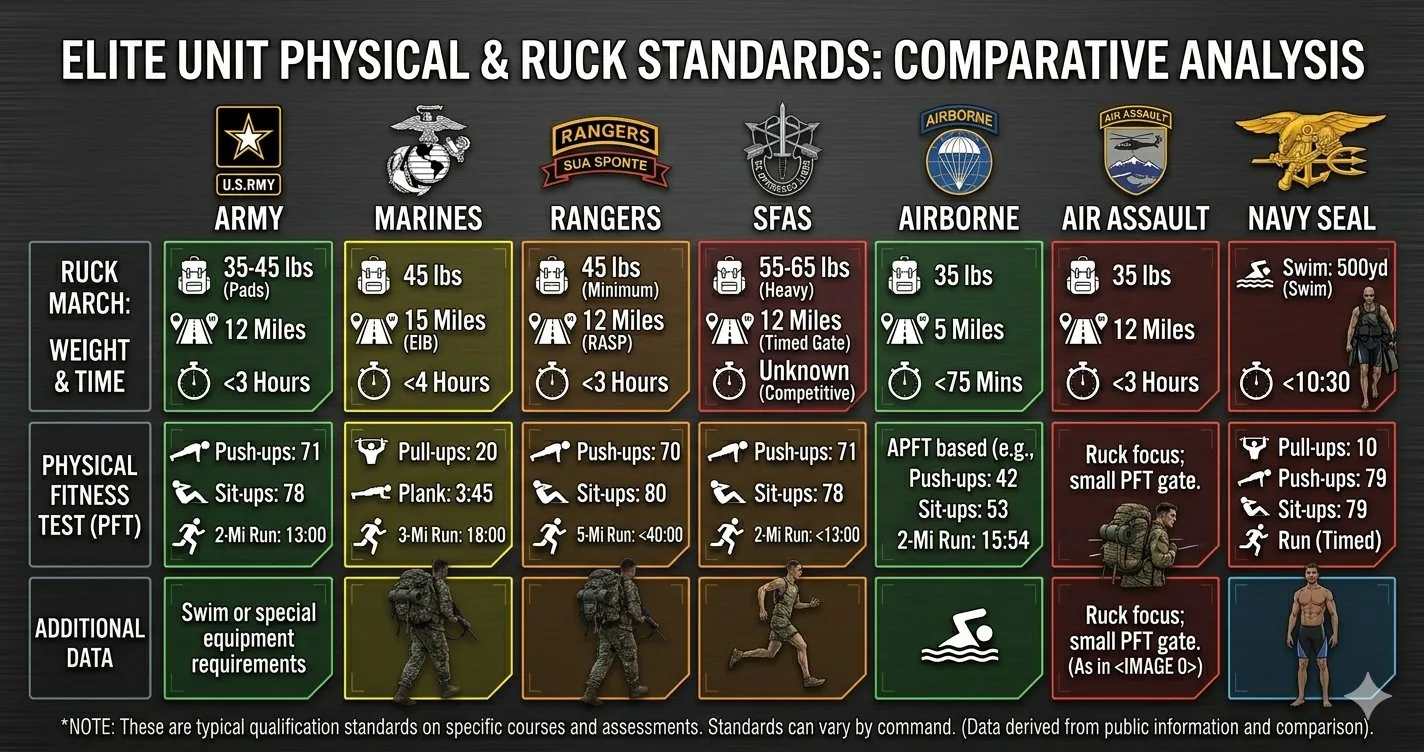
Special Forces Ruck Standards at a Glance
| Course / Benchmark | Distance | Weight | Time |
|---|---|---|---|
| SFAS (prerequisite ruck) | 12 miles | 45–65 lbs (train) | Under 3 hrs (2:36 competitive) |
| RASP (Ranger selection) | 12 miles | 35+ lbs | Under 3 hrs |
| 20-mile SF / combat diver | 20 miles | 45–50 lbs | ~4:30–5:00 (train-up) |
| SFAS culminating march (Trek) | Up to ~32 miles | 45+ lbs | Not published |
| Delta Force "Long Walk" | 40 miles | ~45 lbs | Not published |
Note: the exact pass marks for selection courses are deliberately not released. The figures above combine the Army's public prerequisite standards with the training weights and paces that experienced selection coaches recommend.
Why Rucking Decides SF Selection
Across the studies that have looked at who passes Special Forces Assessment and Selection, ruck performance is the single strongest physical predictor of being selected, ahead of running, pull-ups, or fitness-test scores. That is why selection courses lean so heavily on the rucksack: it tests strength, aerobic endurance, and the willingness to keep moving under load when you are tired, all at once.
One thing to understand up front is that the graded standards at selection are obfuscated on purpose. Candidates sign non-disclosure agreements, and the exact cutoffs for each event are held by a small group of cadre. The numbers below are the Army's public prerequisite standards plus the train-up targets that coaches with selection experience consistently recommend. Treat them as the bar to clear comfortably, not the bar to just barely meet.
SFAS (Special Forces Selection)
The publicly stated physical prerequisites for Army Special Forces include a 12-mile ruck march in under 3 hours (a 15-minute-mile pace) to pass, with a competitive time around 2 hours 36 minutes (13 min/mile). There is also a 5-mile ruck run, with 75 minutes to pass and roughly 50 minutes considered competitive.
SFAS prerequisite ruck standards:
| Event | Pass | Competitive |
|---|---|---|
| 12-mile ruck march | 3:00 (15 min/mi) | 2:36 (13 min/mi) |
| 5-mile ruck run | 75 min | ~50 min |
For training weight, experienced coaches point to roughly 45 to 65 lbs in the rucksack. That range is heavy enough to build real work capacity without inviting the overuse injuries that end a train-up early. Pace matters more than most candidates expect: arriving at selection able to hold only 15-minute miles is widely considered a setup for failure, because at the course you will not have fresh legs, you will not be rested, and the terrain will be uneven. A sustainable 12:30 to 13:30 pace under load is the goal.
Selection itself culminates in a long individual road march, often called "the Trek" or Long Range Individual Movement, that can run up to about 32 miles. Candidates navigate it alone, point to point, without knowing the full route.
RASP (Ranger Selection)
The Ranger Assessment and Selection Program uses a 12-mile ruck as one of its gates. Candidates complete it in under 3 hours at the standard 15-minute-mile pace with a rucksack weighing over 35 lbs. As with SFAS, the published number is a floor; competitive Ranger candidates ruck faster and train heavier.
Ranger School, which comes after selection, runs heavier still, with loads commonly in the 45 to 65 lb range depending on the phase and mission, plus team movements that stretch to 18 miles. If your target is the full Ranger pipeline, see our military ruck standards guide for the branch-by-branch breakdown.
The 20-Mile Ruck & Combat Diver
The 20-mile ruck is not a single official test so much as a classic train-up benchmark for Special Forces and combat diver candidates. It sits in the gap between the 12-mile prerequisite and the much longer selection marches, and it proves you can carry a real load past the point where form and feet usually break down.
Typical 20-mile SF train-up benchmark:
| Component | Target |
|---|---|
| Distance | 20 miles |
| Weight | 45–50 lbs (dry) |
| Pace | 13:30–15 min/mile |
| Finish time | ~4:30–5:00 |
The Combat Diver Qualification Course (CDQC) adds water work to the load-carriage demands, so candidates preparing for it treat the 20-miler as a baseline rather than a peak. Build the distance gradually, and practice on the terrain and in the conditions you expect, because a 20-mile ruck on flat pavement is a very different event from the same distance over hills in heat.
To plan splits for a 20-mile effort, use the ruck pace calculator; to set a safe training load, the ruck weight calculator.
Delta Force: The Long Walk
Selection for 1st Special Forces Operational Detachment-Delta takes place over roughly a month in the mountains of West Virginia and is built around solo land navigation with a steadily heavier pack. An early milestone is an 18-mile night ruck carrying about 40 lbs. The course then builds toward its final event.
That final event is the legendary "Long Walk": a 40-mile march over steep, punishing terrain with a roughly 45-lb rucksack, carried out after candidates are already exhausted. The defining cruelty of it is information, not just distance. Candidates are not told the route, the distance remaining, or the time limit. They simply keep moving from point to point until the cadre tells them to stop. Some accounts of earlier or related courses cite heavier packs, but the modern figure most commonly reported is a 45-lb load with no published time standard.
Navy SEAL Ruck Movements
Naval Special Warfare leans more on swimming and running than on timed ruck marches, so there is no single famous SEAL ruck standard the way there is for Army selection. That said, load carriage is still part of the job. BUD/S and SEAL Qualification Training include conditioning hikes and movements in the 8 to 12 mile range with combat loads of 50 to 70 lbs. Candidates preparing for a SEAL contract should be comfortable carrying a heavy pack for distance, even though the headline events are in the water and on the run.
How to Train for SF Ruck Standards
The training principles are the same across every course on this page, even though the numbers differ. A few points carry the most weight.
Build distance before chasing pace. Get comfortable rucking 8 to 12 miles with 45 lbs at an easy effort before you start timing yourself. Add distance gradually, on the order of 10 percent per week, so your feet, shins, and connective tissue keep up with your ambition.
Train heavier and faster than the floor. If the prerequisite is 35 to 45 lbs at 15-minute miles, train at 50 to 65 lbs and aim for 12:30 to 13:30. The gap between the published standard and your training is the margin that survives bad weather, blisters, and no sleep.
Ruck on real terrain. Selection marches happen on hills, in heat, and over uneven ground while you carry land-navigation gear. Pavement-only training does not prepare your ankles or your pacing for that. Get off the road regularly.
Recover deliberately. Heavy rucking is hard on the body, so keep at least two genuine rest days a week and back off at the first sign of a stress injury. A train-up that lands you at selection healthy beats one that peaks you into the medical tent.
For a week-by-week structure that builds toward the 12-mile, 35+ lb, 3-hour standard, follow our 12-week ruck training plan, and track the energy cost of long sessions with the ruck calorie calculator.
Frequently Asked Questions
What is the Special Forces ruck standard?
The public prerequisite for Army Special Forces is a 12-mile ruck in under 3 hours (15-minute miles), with a competitive time near 2:36. Training weights run 45 to 65 lbs and a competitive pace is 12:30 to 13:30 per mile. The graded standards inside selection itself are not released to the public.
What is the standard for the 20-mile ruck march in Special Forces?
The 20-mile ruck is a train-up benchmark rather than an official graded test. Candidates typically target 20 miles with 45 to 50 lbs at a 13:30 to 15 minute-per-mile pace, finishing in roughly 4.5 to 5 hours. Combat diver candidates use the same distance as a baseline.
How long is the Delta Force Long Walk and how much weight?
The Long Walk is a 40-mile march over steep mountain terrain, carried out at the end of Delta selection with a rucksack of roughly 45 lbs. Candidates are not told the distance or the time limit, which is part of the test.
What is the RASP ruck march requirement?
RASP candidates complete a 12-mile ruck in under 3 hours (15-minute miles) carrying a rucksack of more than 35 lbs. Competitive candidates train heavier and faster than that floor.
How much weight should I ruck with to prepare for selection?
Most selection coaches recommend training in the 45 to 65 lb range. That is heavy enough to build the work capacity selection demands while staying light enough to limit overuse injury. Build up to it gradually rather than starting heavy.
Build Toward Selection Standards
Set your pace, plan your load, and track the energy cost of long rucks with our free calculators.
Go to Calculator →Sources & Methodology
This guide was compiled and fact-checked by The Ruck Calculator editorial team. The figures are standards-based estimates drawn from official U.S. Army foot-march and fitness publications and reputable training references. Military requirements vary by unit, class, and year, so confirm current standards with your chain of command or the school's cadre before testing.
- Headquarters, Department of the Army. TC 3-21.18, Foot Marches.
- Headquarters, Department of the Army. FM 7-22, Holistic Health and Fitness.